Hello. I'm Ki-cheol Cheon, a site reliability engineer (SRE) on the Service Reliability team. Our SRE team is constantly working to provide users with reliable and trustworthy services. Concretely, we're using service level indicator (SLI) and service level objective (SLO) measurements to evaluate the quality and reliability of LINE messaging core services, and we're putting effort into engineering areas such as demand forecasting, performance testing, automation, and strengthening observability. We also help teams communicate and collaborate smoothly.
This article follows Adopting SLI/SLO for improving reliability - Part 1: Introduction and reasons for adoption and Adopting SLI/SLO for improving reliability - Part 2: Platform implementation cases. Here, I'll share our experience defining and applying SLI and SLO across the LINE app's messaging, channels, and authentication services.
Mindset for implementing SLI/SLO
Implementing SLI/SLO is more than just picking metrics — it's really about redefining how you understand a service. To carry out this process successfully, here are the mindsets you'll need.
Understanding and exploring the service
The first thing to do when implementing SLI/SLO is identify what services and features you provide to users. In this process you can create a list of user journeys — the flow of user experience — and identify the critical user journey (CUJ) by defining which features users use most or which features are essential. You can also align SLOs with organizational goals by understanding how the service connects to the business objectives.
Communication and collaboration
SLI/SLO are metrics and goals that should be implemented and managed collaboratively across departments and teams. They shouldn't be defined and implemented by one person or a single team — the goals only become valuable when all stakeholders agree on them. The organization that understands the service best should define the CUJ, the infrastructure team should build an environment that can measure and manage large-scale metrics, and SRE should implement the tools and methods to measure SLIs so SLOs can be used to monitor and manage service reliability.
Here are the roles each organization typically plays.
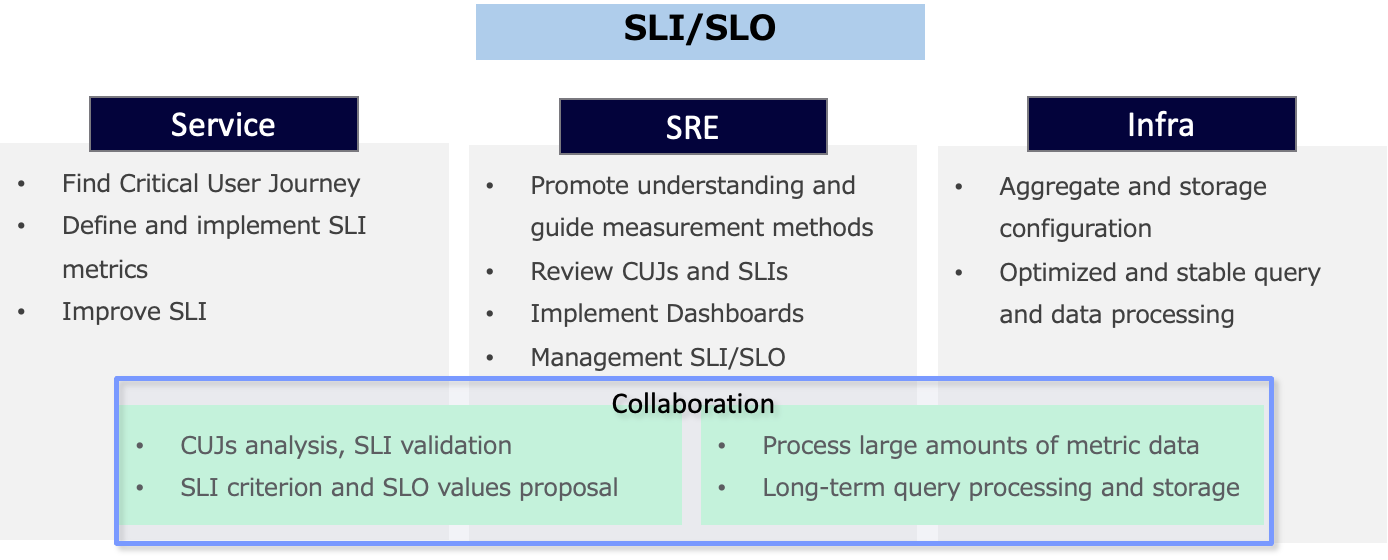
It's important to create a culture where all service stakeholders understand the importance of SLI/SLO and share responsibility for achieving them. Only then can SLOs be used as indicators to confirm that users can use services reliably during operation or when new services or features are released.
SLI/SLO implementation methods
So how do you actually implement SLI/SLO in practice? Let's go through the steps.
CUJ analysis
The first step is to define the CUJ — the key services and features — by considering user experience and business goals.

List the services and features you provide, then ask questions like the following to refine your CUJ.
- What features do users use most in our service?
- What features are essential for users?
For example, you might define core functions such as the LINE service sign-up flow, which is the app's starting point, or the basic messaging send/receive function. Other targets might include authentication and encryption from a security perspective, LINE Login, or profile information features that let users use other services via LINE.
Critical user journey (CUJ)
Focus on selecting key features and services. Consider user experience and business objectives
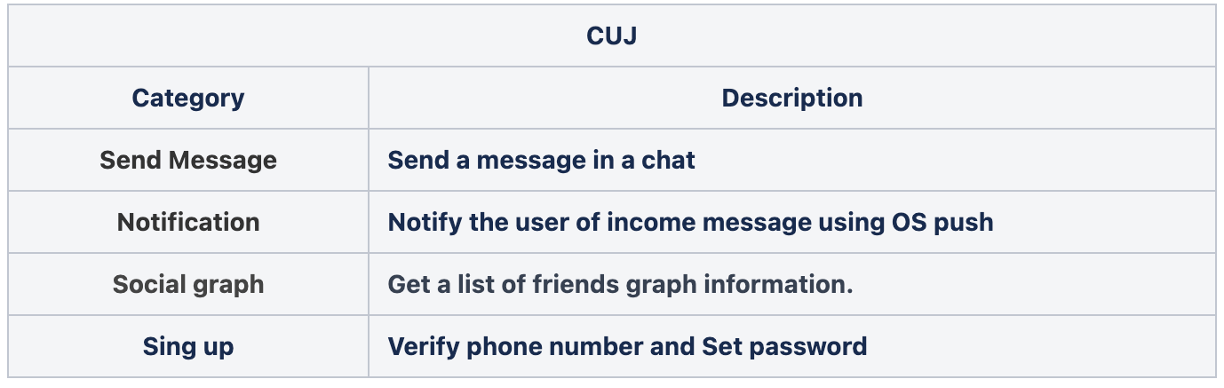
Of course, all services and features are important and need to be reliable, but the key at this stage is to select the most critical targets from the user's perspective.
SLI implementation
Once you've defined CUJs, the next step is to define SLIs.

An SLI defines which metric to set and measure for each CUJ.
- Where will you measure it?
- Choose the location that best captures the metric for each CUJ, such as the gateway, frontend, or backend.
- Which API will you use to measure it?
- Select representative APIs for each CUJ so you don't need to compute metrics in a complex way.
Next, define the SLI criterion that separates success from failure. Generally, you'll measure response time and response success rate. Define each criterion as follows.
- Response time: decide which percentile of overall requests you'll use as the threshold, and what response time will be considered successful for that percentile.
- Response success rate: decide what the success rate must be over the measurement period.
For example, you might define that the response time for the 99.9th percentile of message send requests should be under 500 ms, and that 99.999% of all requests should receive a successful response.

The key in this step is to define the measurement location and target, and a clear criterion that separates success from failure. You must clearly define the success and failure thresholds so you can measure whether an SLO has been met. If there are too many variables to measure or you can't clearly define success and failure, you can exclude that CUJ from measurement. If measurement is complex, we recommend creating separate metrics specifically for the SLI.
SLO target setting
After defining SLIs, you define SLOs.

In this step you define the SLO: the percentage of time during the measurement period that the service must meet the SLI. For example, over twenty-eight days (40,320 minutes), an SLO of 99.9% means the service must meet the SLI for at least 40,280 minutes, so you're allowed about 40 minutes of error budget.
Service level objective (SLO)
The objectives or specific ranges the service needs to achieve, based on the measured SLIs

Set realistic targets that you can actually meet. If you set an SLO too high you'll need to spend more to achieve it, and if you set it too low you'll erode service quality and harm the user experience. Balance reliability and cost when you set SLOs.
Visualization
Finally, build dashboards that visualize the SLIs and SLOs so all stakeholders can quickly see the current SLO status.

Implement a dashboard that summarizes the SLO and the error budget so you can see the overall status at a glance. If you add detailed dashboards for each CUJ you can inspect SLI metrics in more depth.
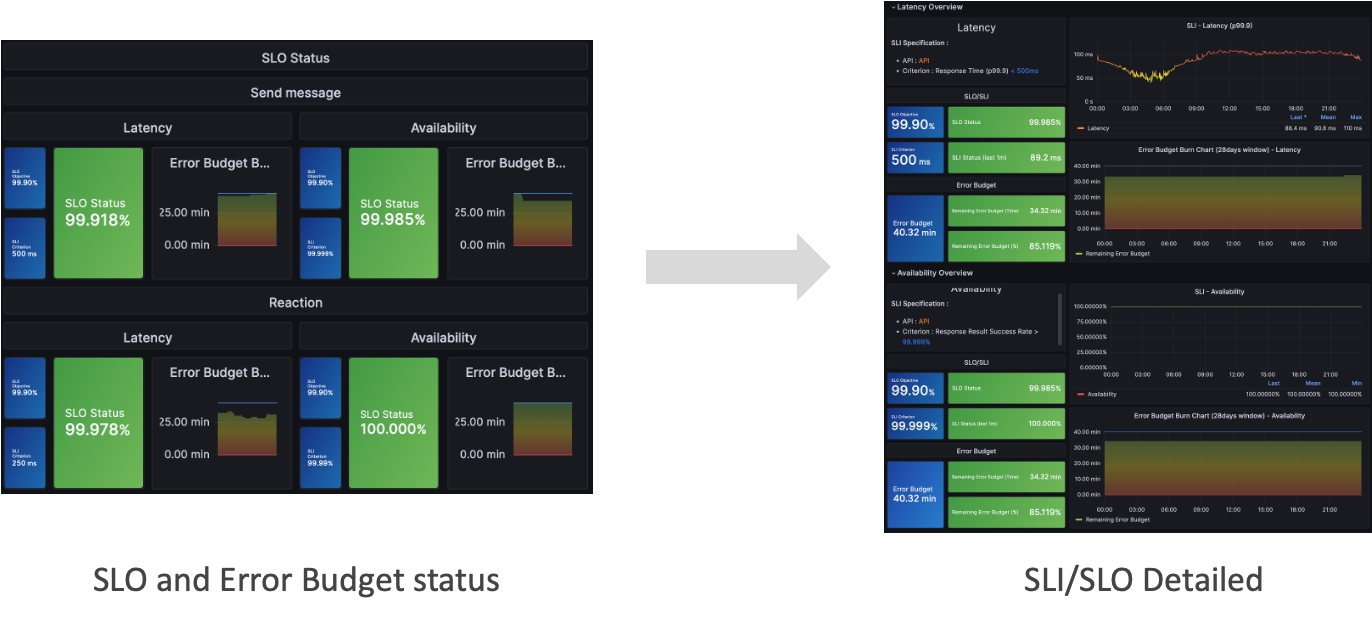
Keep dashboards simple so stakeholders can quickly grasp the overall situation. Use numbers and color to simplify information — for example, show metrics that reliably meet targets in green, items that need attention in orange, and items that have failed to meet targets in red.
SLI/SLO utilization
Now let's look at how to use SLI and SLO.
Quantitative indicators to understand reliability and stability
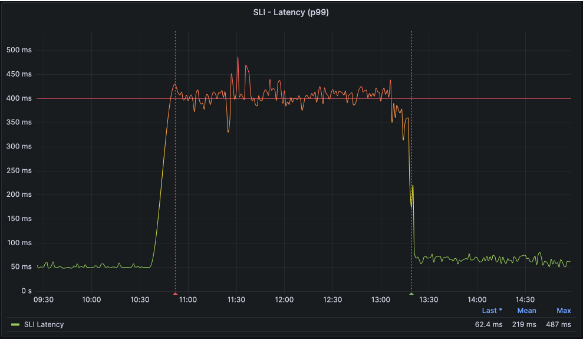
Instead of saying a service is "slower" or "unstable", use SLIs to express the state in quantitative terms. For example, you can say "the service response time exceeds the SLI threshold of 400 ms, causing user inconvenience."
In other cases you might say "our service response success rate is below 99.99%, which is causing user disruption." Dashboards also let you investigate what issues occurred during the periods when the success rate fell short.
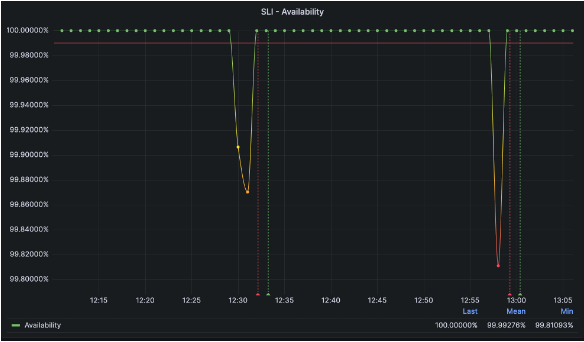
Using quantitative numbers and dashboards makes it easier to monitor and analyze service status.
Use as a basis for resource allocation
SLOs let you check whether targets are being met and use the error budget to determine how much downtime is currently allowable. That in turn helps you estimate how many resources you should invest in preventive and corrective activities to meet SLOs.
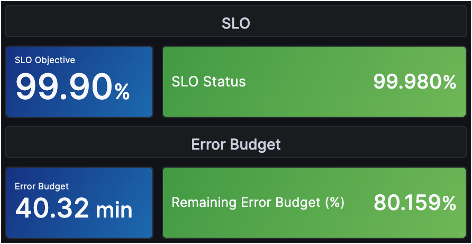
If a service is meeting its SLO and has a generous error budget, you can consider investing more aggressively in new feature releases. For example, if you're exceeding a 99.9% SLO and achieving 99.98% with an error budget above eighty percent, you can deem the service stable and allocate resources to ship new features or shorten release cycles.
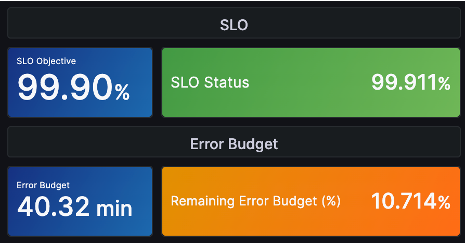
If the error budget is low — for example, only ten percent remains — you should decide to allocate resources to stabilize the service and improve reliability.
Use during on-call response
We apply error budget state alerts to our on-call workflows so teams can quickly understand service status and respond to issues. We also use SLOs in regular meetings to check SLO status and to plan preventive activities to meet targets.
Here are examples of error budget alert messages.


Closing thoughts
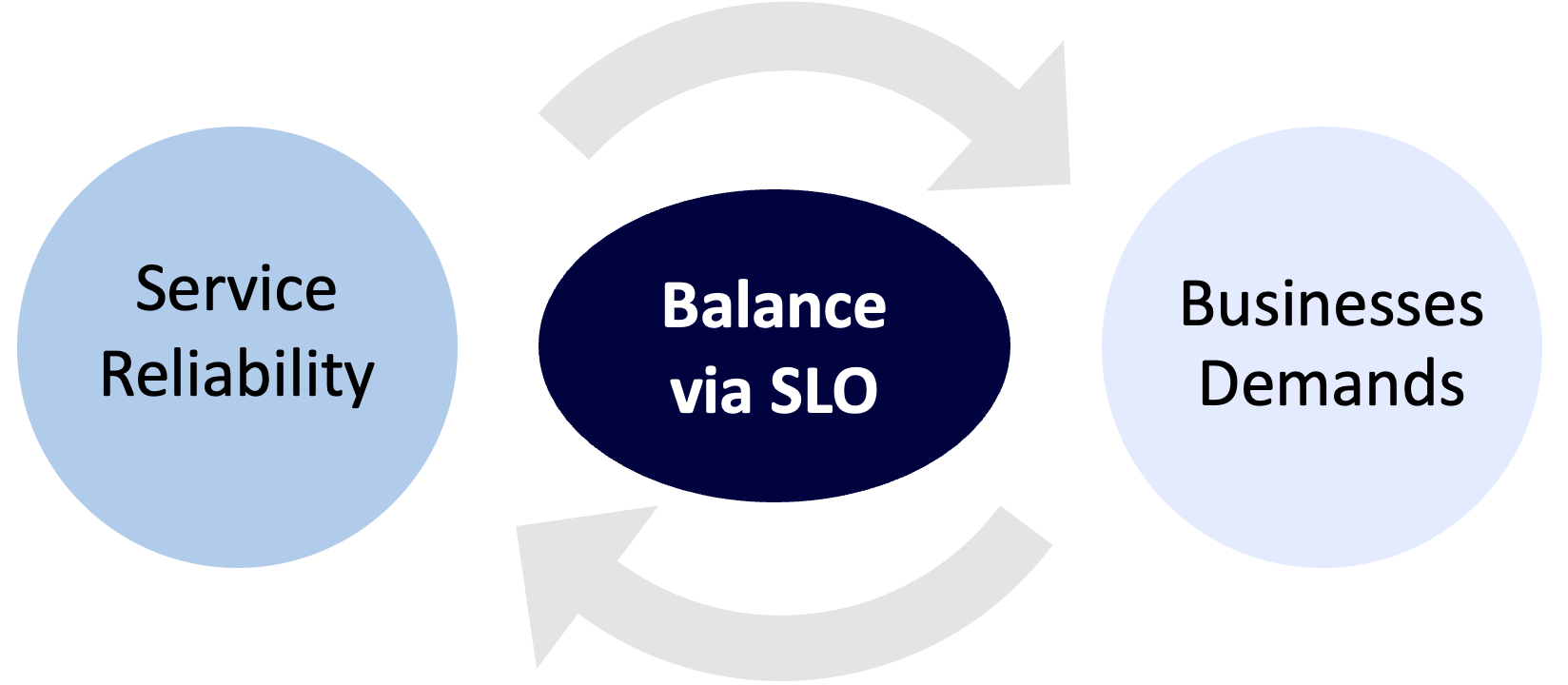
Reliability and stability are core values for any service. At the same time, improving user convenience and delivering new features are critical business goals. I believe SLOs can help balance service reliability with business objectives by providing quantitative targets.
I hope this article helps those who are interested in or planning to adopt SLI and SLO. I'll close by sharing a short statement that summarizes my view of the SRE role. Thanks for reading.
Core tenets of SRE
Focus on providing stability and reliability to our customers
And strive for continuous improvement and innovation.