Hello, I’m Young Hee Park from the Cloud Service CBU, where I’m responsible for the private cloud that supports our development services.
LY Corporation has built and operates an internal private cloud to provide the infrastructure and platforms our engineers need to develop services. We’re now integrating the cloud services previously used at Yahoo! JAPAN and LINE (prior to the merger) into a single, unified platform. The name of this new integrated private cloud is Flava.

Rather than trying to predict how the entire cloud industry will evolve, this article focuses on how Flava will evolve from two specific perspectives.
Flava’s future (1): Flavaization, usable security, and user data storage
Let’s start with three areas that will make Flava a stronger cloud foundation.
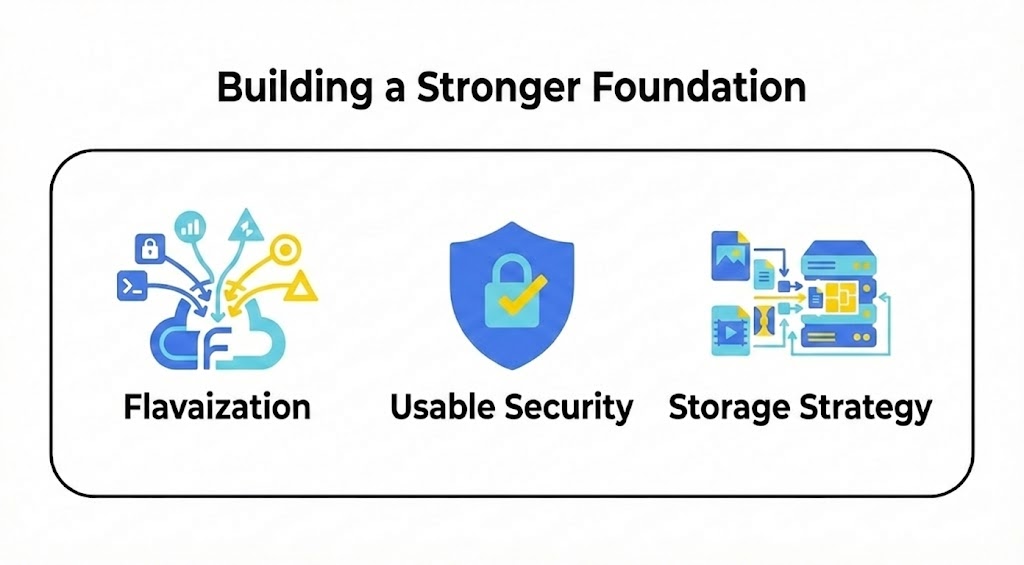
Platform “Flavaization” to improve developer experience
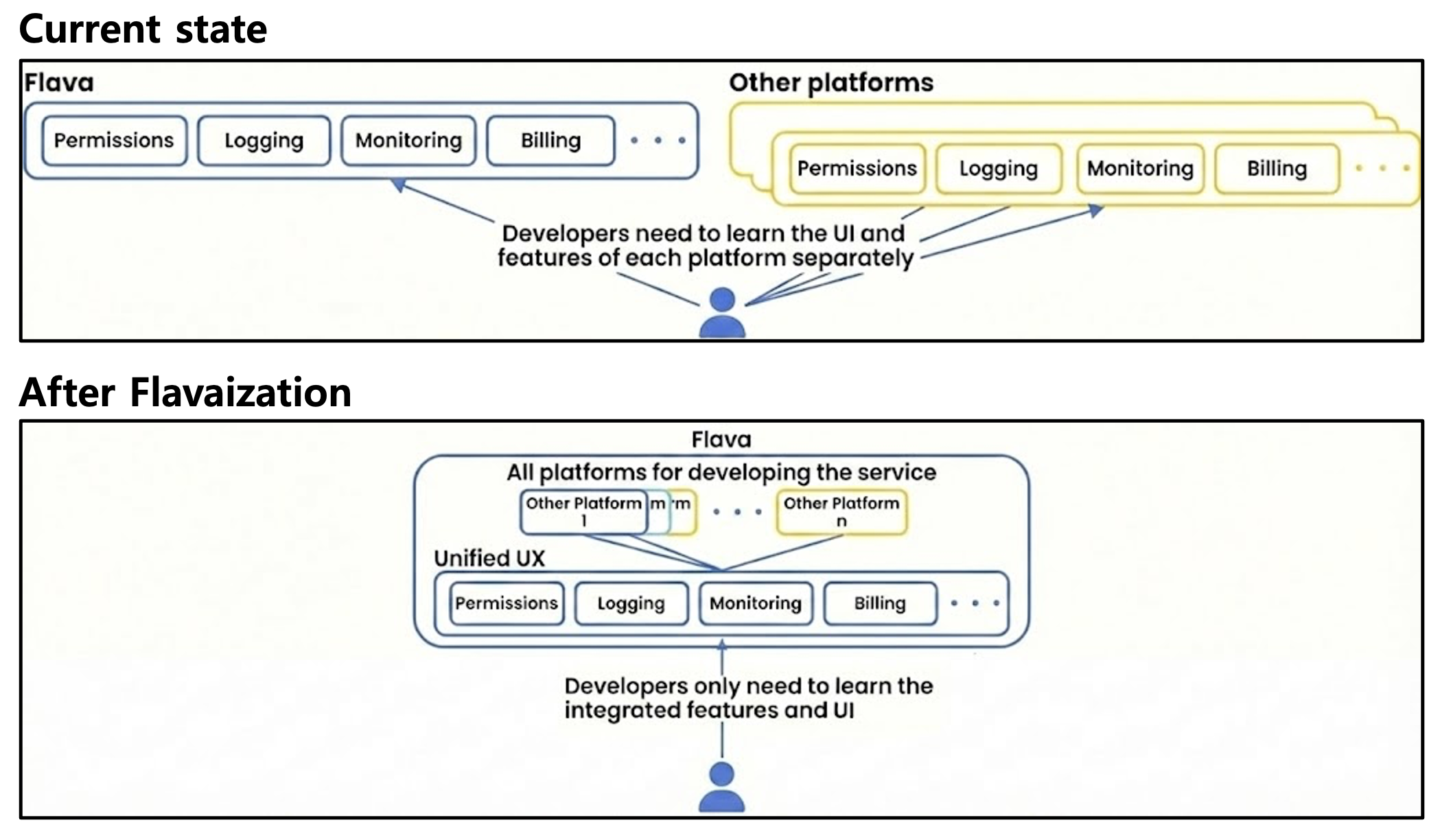
Today, Flava is centered around infrastructure, databases, and containers. Many other products and services required for development are still spread across multiple internal platforms. Because these platforms don’t yet provide a unified “cloud experience,” developers often have to learn separate ways to handle things like permission management, logging and monitoring, metering and billing, APIs and CLIs, UIs, approvals, and multi-region/availability zone (AZ) capabilities, platform by platform.
To address this, we believe Flava’s near-term priority should be to provide all platforms needed for service development as cloud services, with a consistent UX and shared foundations. We call this effort “Flavaization” of platforms. As awareness of Flava has grown across the company, more organizations have started moving in this direction. Given that momentum, we’re hopeful we can complete major Flavaization work within the next one to two years.
Security that’s both robust and genuinely usable
One of Flava’s strengths, compared to public clouds, is that it meets our internal security governance requirements, and implements them directly at the cloud platform level.
From the architecture and product-planning stages, Flava has worked closely with the Chief Information Security Officer (CISO) organization, and every product goes through internal security evaluation. We separate cloud environments based on data security level (for example: default, secret, and top secret), and store and process data for each level in isolated ways. We also clearly partition permissions that allow changes in the cloud, and for high-impact actions we require an approval process, typically including reviews by specialized organizations after internal reporting.
Public clouds don’t include this kind of company-specific governance out of the box. As a result, teams adopting public cloud services often need to consult with the CISO organization separately and build their own approval processes around cloud usage.
That said, there’s still work to do. When we evaluated these governance features from a user’s perspective after development, we found many areas where usability needs improvement.
For example, we used to spend 1-2 months physically building secure environments. In the current Flava security environment, resources can be provisioned in minutes, but accessing those servers can still require roughly 10 separate workflows, such as creating VDI accounts or setting up Box folders for data exchange. Because these steps involve approvals, the end-to-end lead time can still be as long as two months.
As another example, stronger access control (such as VPC ACL enforcement) can add several milliseconds of latency. That may be acceptable for many applications, but for services that demand extremely fast network response times, like the LINE messaging app, even a few milliseconds matter. Requests to improve VPC ACL processing performance are something we take very seriously.
If security is strong but difficult to use, users will naturally avoid it. From the perspective of “usable security,” Flava’s next challenge is to deliver security that is both highly robust and highly usable.
Storage and related technologies for rapidly growing multimedia data
In the mobile era, one notable change in user behavior is the sheer volume of multimedia content each person creates. Taking photos and videos has become routine; even on my own devices, the LINE app has albums containing thousands of images.
Once created, most of this data is stored for a long time and rarely deleted. In other words, even if service traffic stays flat, the amount of user-generated multimedia that must be stored continues to grow. From a service perspective, we also need better ways to present and manage that data for users. From a cloud perspective, we need storage that is cost-effective while still offering reasonable access times.
This means we must invest in multiple storage technologies that match different stages of the data lifecycle. Important considerations include cost, throughput, latency, searchability, compression, deduplication, and encryption. For companies running large-scale IT services, building these capabilities is essential.
Flava’s future (2): Flava and AI
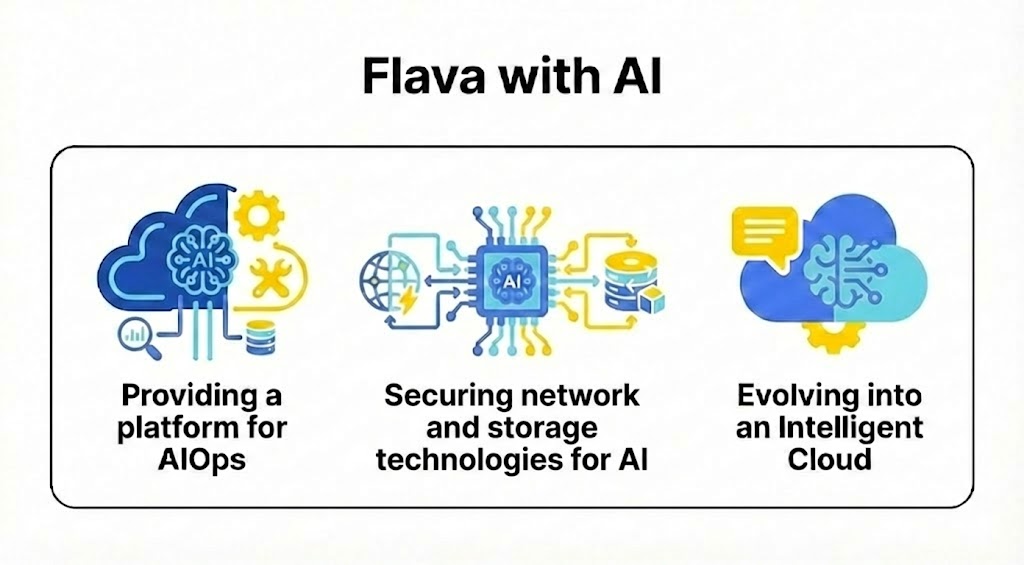
Like many other areas of technology, the future of cloud can’t be discussed without AI. Today, Flava is approaching AI from three perspectives.
Providing tools for AIOps
First is enabling artificial intelligence for IT Operations (AIOps).
Across LY Corporation, many organizations, including engineering teams, are actively adopting AI to improve productivity. To build AI tools and agents, teams need supporting platforms: for example, platforms to create and manage company-approved model context protocol (MCP) servers; vector database platforms; AI observability tools such as Langfuse for debugging tool development; and systems to manage AI models. These platforms are evolving so quickly that it’s difficult to keep up.
Because AI tools and agents interact with many kinds of data, they must be developed and operated in compliance with internal data-handling and security policies. That’s why it’s important to quickly identify which AI development platforms teams are adopting, and then provide standardized, compliant versions as shared cloud platforms for the company.
Building lower-layer technologies for AI
Second is work at a lower layer, especially networking and storage.
AI services process far more data than many traditional systems and often require extremely low network latency. As a result, technologies like data processing units (DPU) and smart NICs are gaining importance worldwide. On the storage side, ultra-fast NVMe-based systems and automated storage tiering are also expected to advance significantly.
Cloud is fundamentally a collection of technologies spanning many domains. Networking and storage have been studied for decades, yet they still contain hard problems, particularly at cloud scale where hundreds of thousands of servers must operate together. Achieving low latency, high stability, fault tolerance, throughput, safe change management, and strong security at that scale is not easy. Hiring engineers in these areas is also extremely challenging.
Fortunately, Flava has teams specializing in cloud networking and storage, and we’ve matured these technologies through years of operating large-scale infrastructure for services related to LINE and Yahoo! JAPAN. We’re also well positioned to evolve our networking and storage stack to support large-scale AI workloads.
Evolving into an intelligent cloud
Third is an AI-integrated “intelligent cloud”. Today, we manage cloud resources through web UIs, APIs, CLIs, and infrastructure as code (IaC) tools like Terraform. In the AI era, however, we expect the way people interact with clouds to change significantly.
Imagine requirements like the following:
“Our service receives 30,000 image uploads per second, generates five types of thumbnails, and stores related history in a log system through a message queue. Uploaded images are checked by an AI-based preprocessor for adult or violent content, and labels are applied when needed. We also analyze access patterns: frequently accessed images are stored in low-latency, high-throughput storage; infrequently accessed images are stored in cheaper storage that can retrieve within one second; and images not accessed for even longer are moved to a third tier that’s the lowest cost but can still be downloaded within three hours.”
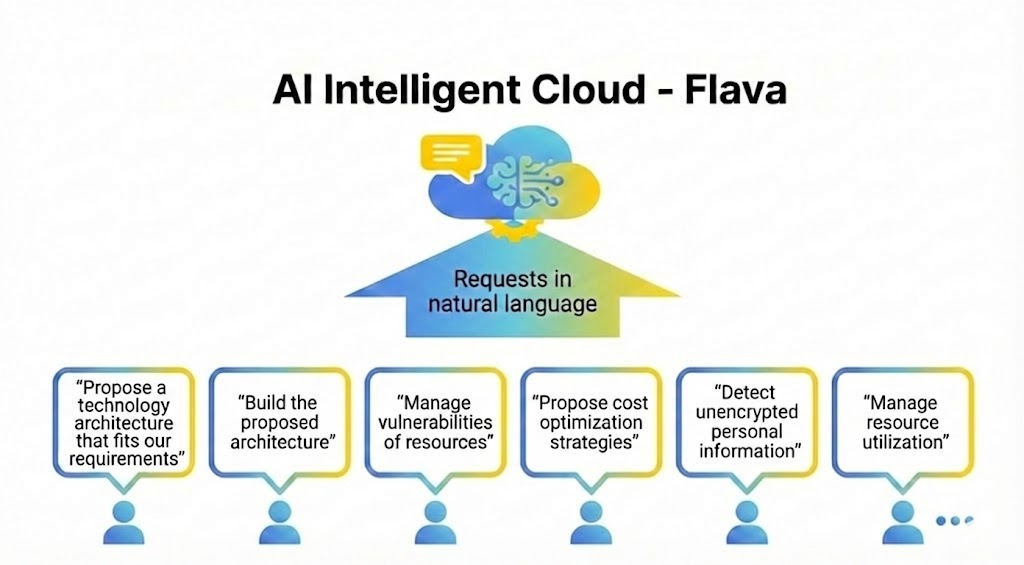
Today, building a system like that typically requires developers, infrastructure engineers, and platform experts to collaborate by designing an architecture and selecting solutions. In the future, we expect that you’ll be able to enter requirements like this in natural language and have the cloud propose an implementable architecture, and then provision and configure it automatically.
Similarly, if someone requests, “Draw a network diagram for Project A and generate an ACL matrix based on source/destination criteria”, an intelligent cloud could produce both the diagram and the ACL matrix. Public cloud providers have already begun demonstrating combinations of LLMs and cloud workflows. Flava also aims to evolve in this direction, making Flava dramatically easier and more convenient to use.
We also expect future intelligent clouds to take on responsibilities such as vulnerability management across vast numbers of resources, cost optimization recommendations, resource utilization monitoring, and detection of unencrypted personal information. Flava has already begun prototyping in these areas. Work like company-wide “low-usage resource efficiency campaigns”, which previously required significant effort from many engineers, could be handled by Flava chatbots.
For example, in Project A, you might review an AI-selected list of low-usage resources, compare Project A’s utilization against organization-wide benchmarks, and identify whether Project A falls into a bottom percentile that requires attention. At that point, you could ask Flava:
“Define low-usage criteria for Project A, generate a list of low-usage resources, and propose cost-reduction options. Show failover standby servers separately, and propose additional savings specifically for underutilized failover resources.”
Other requests could include:
“On the 1st of every month, check whether our databases, logs, and object storage contain data that appears to be user personal information and is not encrypted.”
“Create a prioritized list of servers with OSS vulnerabilities and categorize them by remediation plan.”
Up to now, many of these tasks have been handled directly by individuals or teams. In the future, we expect these responsibilities to shift toward dedicated “AI intelligent cloud” capabilities that can execute this work continuously and reliably on our behalf.
Conclusion
In this article, we explored a realistic view of what cloud could look like within the next two to three years. This is not a distant, speculative future. Cloud is a convergence of many technologies. Building the cloud of the future requires deep expertise in lower-layer systems, the ability to adopt cutting-edge global technologies, and the product mindset to design developer-facing platforms with excellent UX, while operating them reliably and cost-effectively. That kind of work is only possible when strong engineers across many disciplines come together.
Sharing knowledge, imagining what’s next, and then executing on it is genuinely exciting. Building tools also forces us to understand user experience firsthand, deepen our technical capabilities, and turn ideas into real services that deliver value to users.
Creating the future of cloud isn’t limited to Silicon Valley. If we allow ourselves to dream and then work to make those dreams real, we can build something remarkable here as well. Flava will continue exploring new technologies, envisioning a better cloud world, and executing steadily toward it. We appreciate your support.